Further Training in Wilderness Education II 2027/2028
Highlights
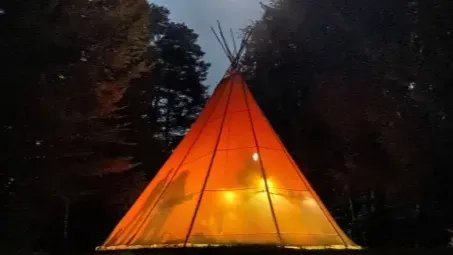
A few impressions to give you a feel for this class.
About this Course
Purpose and Scope
The part-time Wilderness Education II training builds on the knowledge and experience gained in the one-year Wilderness Education program.
Across five modules comprising a total of 24 course days, we will explore new ways of connecting with nature and expand our awareness and wilderness skills. Independent study with topic-related assignments between the modules will help supplement our knowledge and personal experience.
As a stable group, we will intensively explore new wilderness elements, deepen our existing knowledge, and strengthen our sense of belonging to this place. Through our connection with nature and ourselves, we can also accompany other people on their journey as mentors.
Available dates
Contents
The contents of the course are:
- Wild plants in the different seasons
- Wild plant cuisine using edible wild plants (buds, leaves, flowers, seeds, wild fruits, and roots)
- Tracking and sign identification in Emilia-Romagna, Italy
- Traditional knowledge of birds
- Primitive Skills
- Living through the cold season
- Fire – different methods
- Primitive cooking methods
- Wilderness camp – living in community
- Wilderness living in Sweden
- Expanding our perception and merging with nature
- Rituals, Inner Tracking, and solo time
- Nature mentoring
- Self-study
Structure
Module 1 – Primitive Skills and Ancient Bird Lore
To begin our joint training, we will rediscover old skills and learn primitive skills, including sewing containers from rawhide, pottery, and old fire-making techniques. We will deepen our knowledge of ancient bird lore and the language of birds on an excursion.
Module 2 – Tracking and Sign in Italy
Our camp and tracking area are located in the mountains of Emilia-Romagna, Italy. During our 5-day wilderness journey, we will follow the tracks and trails of, among others, red deer, roe deer, wolves, foxes, and porcupines, immersing ourselves in the ways of life and behavior, and the habitats, of these different animal species.
Module 3 – Wintertime
During the cold and quiet season, we will turn to the themes of the North and Northeast and apply the survival knowledge we have learned to the cold season.
Module 4 – Wild Plants
Wild plants not only provide us with a food source in a survival situation, but also allow us to complement and replace cultivated plants, thereby making us more independent. Gathering and preparation methods throughout the yearly cycle—from buds, leaves, flowers, and seeds to wild fruits and roots—offer us many ways to nourish ourselves with wild plants.
Module 5 – Wild Living – Sweden
In the Swedish wilderness, we will experience the natural world in its original state as a community. We will find our campsites on remote islands and beautiful spots by lakes. Wild plants, berries, mushrooms, and fish that nature offers us at this time of year will enrich our menu. Rituals and a solo period will connect us with ourselves and with nature.
Prerequisites
Wilderness Education II is aimed at anyone who has successfully completed a one-year wilderness education course at a wilderness school and wants to continue on this path.
Board & Overnight
Camps in Upper Bavaria. The 2nd module—tracking and sign identification—takes place in Emilia-Romagna, Italy. The 3rd module is at a mountain hut in Upper Bavaria, and the 5th module is in central Sweden. Most of the training takes place outdoors. You will need your own camping equipment. Participants are responsible for their own travel to the locations.
Certificate
The Wildnispädagogik II training course concludes with a certificate. In addition to regular attendance at the modules, documenting the independent study is a requirement for obtaining the certificate. The certificate provides information about the teaching topics and content.
Cost Structure
The cost of the training is € 1,980. Payment for the training is in 4 installments. An additional € 680 is payable for site rental/food/course materials/canoe rental. Participants arrange their own travel.
Reviews
WildNet.Earth Review Policy
Each rating result ranges from 1 to 10. The overall rating for a course is calculated by adding up all the ratings submitted and dividing them by the number of ratings. We use a weighted system: more recent ratings have a greater influence on the overall result.
Participants can also submit sub-ratings for important course areas – such as organizer communication, course management, content & learning progress, procedure & implementation, venue, catering, and accommodation. Sub-ratings and overall ratings are assigned independently of each other and are not necessarily directly related.
Participants can submit a review if they have taken part in a course via WildNet.Earth – even if they have not completed the course in full. In addition, participants can verify themselves and also write reviews even if they have not booked via WildNet.Earth. Changes to reviews that have already been submitted can only be made via WildNet customer service.
To prevent bias, WildNet.Earth uses processes that identify fake or unreliable reviews. Such content will be deleted and measures may be taken against those responsible. Suspicious posts can be reported to customer service by anyone at any time.
We publish both positive and negative reviews, unless they contain or refer to:
- Politically sensitive content
- Advertising
- Illegal activities
- Personal or sensitive data (e.g., phone numbers, email addresses)
- Insults, obscene language, sexualized content, hate speech, discrimination, threats, or violence
- Spam or obviously fake content
- Identity theft
- Any violation of our rating guidelines
Guidelines and standards for reviews
These guidelines ensure that reviews on WildNet.Earth remain relevant, fair, and respectful—without restricting freedom of expression.
Contributions should have a clear connection to the course or experience and help other participants make an informed decision. Personal attacks, religious or political statements, advertising, or support requests (to the organizer or WildNet.Earth) do not belong in reviews and will be removed.
Posts must be suitable for a global audience. Obscenities (even in creative writing) and content that contains hate, discrimination, violence, sexual depictions, or illegal activities are not permitted.
All content must be authentic, independent, and unbiased. Organizers and their partners may not create reviews on behalf of their participants or offer incentives for reviews. Attempts at manipulation (e.g., negative reviews against other organizers) will not be tolerated.
Personal data of third parties may not be published. Copyrights must be observed—published content, especially images, may only be used if the corresponding rights have been obtained.
The opinions expressed are solely those of participants and course providers. WildNet.Earth accepts no liability for reviews or responses. WildNet.Earth acts as a distributor, not as a publisher of content.
Reviews are sorted according to recency and other relevance criteria (e.g., language, reviews with text, etc.). Additional sorting options may be available.
Weiterbildung Wildnispädagogik II 2027/2028
Rate your experience
Thank you for sharing your experiences. Your feedback helps other participants and supports the organizers in quality assurance.
A quick login is required to submit a review.
This ensures that only actual participants submit reviews, which increases the relevance of the reviews.
About the Organizer
Waapiti
Wildnisschule Waapiti Das Anliegen unserer Natur- und Wildnisschule Waapiti, die wir 2008 gegründet haben, ist es, große und kleine Leute wieder in Verbindung mit der Natur zu bringen, um sich dort zuhause und geborgen zu fühlen. Eine innere und äußere Verbundenheit mit der Natur lässt uns die natürlichen Zyklen und vielfältigen Zusammenhänge erfahren, unsere Intuition wird feiner und die Wertschätzung aller Geschenke aus der Natur erfüllt uns.
Zu unseren Weiterbildungen gehört die einjährige Wildnispädagogik I in Oberbayern und auf der Schwäbischen Alb. Durch das Erleben der Natur mit allen Sinnen, der Aktivierung unserer Wahrnehmung und durch eigene unmittelbare Erfahrungen verbinden wir uns mit der Natur und leben im Einklang mit ihr. Schwerpunkte der Weiterbildung sind u.a. Vogelsprache, Naturmentoring, Leben in Gemeinschaft, Pflanzenwissen, Spurenlesen, Survivalfertigkeiten, Outdoor-Erste-Hilfe und Naturhandwerk. Darauf aufbauend bieten wir eine Wildnispädagogik II Weiterbildung an.
Unsere Ausbildung Outdoor-Guide verbindet das ursprüngliche Wissen um das Leben von und mit der Natur mit neuen Ausrüstungen, um sich sicher in der Wildnis bewegen zu können und sich draußen zu Hause zu fühlen. Zu den Inhalten der Ausbildung gehört u.a. Wilderness-Survival, eine Trekkingtour in Kroatien, Orientierung und Tourenplanung, Krisenmanagement und Gruppendynamik, Kenntnisse über natürliche Gefahren, eine Kanutour in Schweden und Schneetouren.
Ebenso bieten wir Kanutouren in Schweden und Kanada (Yukon) an.
Unsere Weiterbildung WildpflanzenPädagogik befasst sich intensiv und praktisch mit unterschiedlichen Themenbereichen mit und zu den Pflanzen im Jahreskreis.
Seit einigen Jahren begleiten wir Menschen bei ihrer Visionssuche. Die Visionssuche ist ein rituell gestalteter Übergang und es können Lebensübergänge bewusst begangen werden.
Bei unseren Wildniskursen entdecken wir die Welt des Naturhandwerks wie Gerben, Weidenflechten und Bogenbau. Spuren und Fährten entdecken wir bei unserer Wildnisreise in Italien. Gemeinschaft erleben wir in unserem Familiencamp und bei unserem Kurs Wildes Kochen. In die Sprache des Waldes tauchen wir bei unserem Kurs Vogelsprache ein und bei unserem Outdoor-Erste-Hilfe Kurs bereitet wir uns auf medizinische Notfälle in der Natur- und Wildnis vor.
Hundreds more courses in 30+ categories
Not found what you are looking for yet? Discover many more courses in our course finder.