Advanced Course in Wilderness Education and Connection with Nature 2026/27
About this Class
WILDERNESS EDUCATION: DEFINITION AND BASIC ROUTINES
Definition of Wilderness Education
It is an attempt to rediscover and live with perception and respect for creation, by reconnecting with oral Indigenous sources. This includes cognitively getting to know the flora and fauna, as well as developing a subtle sensitivity to the way nature speaks in the landscape around us. We encourage original learning, learning with the mammalian brain, which is responsible for sensory perception, emotions, and relationships. Our fundamental goal is to awaken and refine this innate wilderness awareness, this natural intelligence. (Coyote Guide) Appropriate training enables these new imprints to be carried over into the “wilderness of civilization.”
BASIC ROUTINES OF WILDERNESS EDUCATION
- Gratitude: describing the elements and their effects in poetic language, fostering an attitude of gratitude, alignment, and the straightening of energy
- Sit spot: finding a sit spot, writing a weekly sit-spot report
- Wide-angle vision: releasing the focus, breaking old routines
- BowDrill: getting to know different types of wood, practicing craftsmanship, practicing patience
- Journal: nature observations, the story of the day, dreams
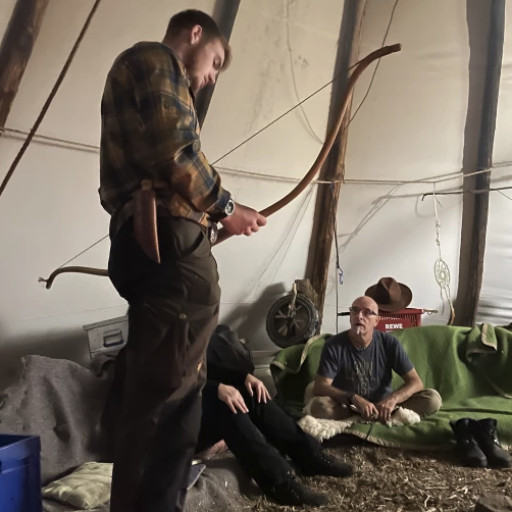
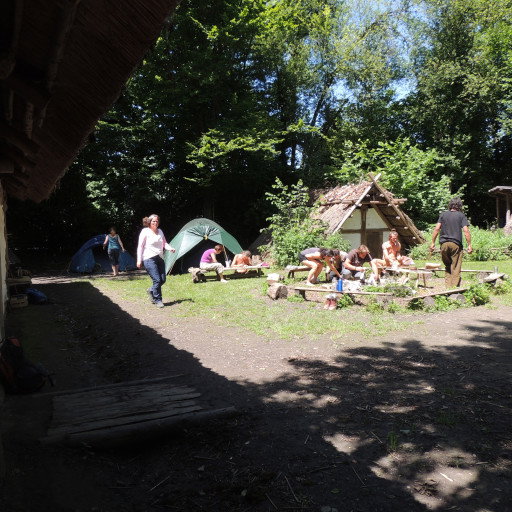
To participate in the WPII advanced course, applicants must have completed a one-year Wilderness Education Foundation Course at a recognized wilderness school. Building on the Wilderness Education Foundation Course, you will learn to become part of the living world around you with even more detailed knowledge and greater empathy. The six weekends, featuring practical craftwork (bow-making or drum-making), clan life, talking circles, shared meals, tracking, bird language, fasting, and sweat lodges, are spread over one year. Upon completion, participants receive a certificate from the wilderness school.
Instructors: Wilfried Mengs: wilderness education, games, activities, music, ceremonies Kristin Stenitschka: herbs, wild cuisine, animal and plant studies Christoph Adler: bow-making Daniela Schmidt: drum-making
(Modules usually begin at 19.00 with dinner; overnight accommodation is in your own tent.)
Duration: 1 year, meaning 6 modules over 6 weekends, 1 internship at a WP event (the modules each begin at 19.00 with dinner; overnight accommodation is in your own tent)
WPII 25/26 - Dates:
WPII 26/27:
06.05.- 10.05.26 fasting hike, sweat lodge, 12.- 14.06.25 bird language / tracking, 25.- 27.09.26 drum-making, 23.- 25.10.26 Philosophy (methods for conflict resolution, group cohesion, and reflection), 19.- 21.02.27 winter camp, 08.- 11.04.27 Woodruff, sweat lodge
(the modules each begin at 19.00 with dinner; overnight accommodation is in your own tent)
Available dates
There are currently no upcoming dates for this class. However, you can express your interest in future events by putting yourself on the waiting list.
Contents
- New routines as awareness training
- Coyote Teaching, natural learning and teaching methods,
- Vision quest, sweat lodge,
- Medicine walk, pushing your limits
- Commitment and appreciation
- Talking circle as a consensus-building method
- Tracking
- Bird language
- Orienteering – drawing and using maps
- Drum building,
- Camouflage, wildlife observation,
- Forest ecology, ornithology
- Clan life
- Ceremonies
- Creating and presenting stories
Completing the homework is part of the training and is therefore required. (approx. 4 hours per week)
Certificate
After successfully completing the examination, participants receive a certificate from the provider.
Reviews
WildNet.Earth Review Policy
Each rating result ranges from 1 to 10. The overall rating for a class is calculated by adding up all the ratings submitted and dividing them by the number of ratings. We use a weighted system: more recent ratings have a greater influence on the overall result.
Participants can also submit sub-ratings for important class areas – such as organizer communication, class management, content & learning progress, procedure & implementation, venue, catering, and accommodation. Sub-ratings and overall ratings are assigned independently of each other and are not necessarily directly related.
Participants can submit a review if they have taken part in a class via WildNet.Earth – even if they have not completed the class in full. In addition, participants can verify themselves and also write reviews even if they have not booked via WildNet.Earth. Changes to reviews that have already been submitted can only be made via WildNet customer service.
To prevent bias, WildNet.Earth uses processes that identify fake or unreliable reviews. Such content will be deleted and measures may be taken against those responsible. Suspicious posts can be reported to customer service by anyone at any time.
We publish both positive and negative reviews, unless they contain or refer to:
- Politically sensitive content
- Advertising
- Illegal activities
- Personal or sensitive data (e.g., phone numbers, email addresses)
- Insults, obscene language, sexualized content, hate speech, discrimination, threats, or violence
- Spam or obviously fake content
- Identity theft
- Any violation of our rating guidelines
Guidelines and standards for reviews
These guidelines ensure that reviews on WildNet.Earth remain relevant, fair, and respectful—without restricting freedom of expression.
Contributions should have a clear connection to the class or experience and help other participants make an informed decision. Personal attacks, religious or political statements, advertising, or support requests (to the organizer or WildNet.Earth) do not belong in reviews and will be removed.
Posts must be suitable for a global audience. Obscenities (even in creative writing) and content that contains hate, discrimination, violence, sexual depictions, or illegal activities are not permitted.
All content must be authentic, independent, and unbiased. Organizers and their partners may not create reviews on behalf of their participants or offer incentives for reviews. Attempts at manipulation (e.g., negative reviews against other organizers) will not be tolerated.
Personal data of third parties may not be published. Copyrights must be observed—published content, especially images, may only be used if the corresponding rights have been obtained.
The opinions expressed are solely those of participants and class providers. WildNet.Earth accepts no liability for reviews or responses. WildNet.Earth acts as a distributor, not as a publisher of content.
Reviews are sorted according to recency and other relevance criteria (e.g., language, reviews with text, etc.). Additional sorting options may be available.
Aufbaukurs Wildnispädagogik und Naturverbindung 2026/27
Rate your experience
Thank you for sharing your experiences. Your feedback helps other participants and supports the organizers in quality assurance.
A quick login is required to submit a review.
This ensures that only actual participants submit reviews, which increases the relevance of the reviews.
More classes from this school

Similar classes in this category





About the Organizer
Wildnisschule Trappercamp
The wilderness education we teach is based on the principles of Wilderness Awareness / wilderness education
We teach and support an approach rooted in connection with the landscape, and want to develop and foster a connection with nature among our guests. This leads to an awareness of sustainability and resource conservation, as well as sensitivity to energy consumption. We teach care and respect for the world around us, for all living beings, and for life in general. This is what we mean, in the deepest sense, by education for sustainable development. Rather than focusing on one-off activism, we place value on awakening a longing for connection with nature. Learning about flora and fauna as a foundation for mindfulness. Exploring the inner wilderness / a mature, self-responsible personality takes shape. Expanding one's comfort zone and learning to love experiencing the elements. Learning through experience / Coyote Teaching Learning practical skills and creating with natural materials Orientation and navigation As a private business, we see our primary purpose not as maximizing profit, but as communicating the values that matter to us.
Die von uns gelehrte Wildnispädagogik basiert auf den Grundlagen der Wilderness Awareness/ Wildnispädagogik
Wir lehren und unterstützen den Ansatz der Verbundenheit mit der Landschaft und wollen bei unseren Gästen Naturverbindung entwickeln und fördern. Daraus folgt das Bewusstsein von Nachhaltigkeit und Ressourcenschonung und eine Sensibilität für Energieverbrauch. Wir lehren Achtung und Respekt vor der Mitwelt, den Mit- Lebewesen und dem Leben allgemein. Damit ist zutiefst Bildung zu nachhaltiger Entwicklung gemeint. Wir setzen weniger auf punktuellen Aktionismus, sondern legen Wert auf das Erwachen einer Sehnsucht nach Naturverbindung. Wissensbildung zu Flora& Fauna als Grundlage für Achtsamkeit. Erforschung der inneren Wildnis/ eine reife, selbstverantwortliche Persönlichkeit entsteht. Erweiterung der Komfortzone, das Erleben der Elemente lieben lernen. Lernen durch Erfahrung/ Coyote Teaching handwerkliches Lernen und Gestalten mit Naturmaterialien Orientierung und Navigation Als privates Unternehmen sehen wir unseren primären Sinn nicht in Gewinnmaximierung sondern in der Vermittlung unserer Anliegen.
Hundreds more classes in 30+ categories
Not found what you are looking for yet? Discover many more classes in our class finder.