
Track and Sign Training
About this Class
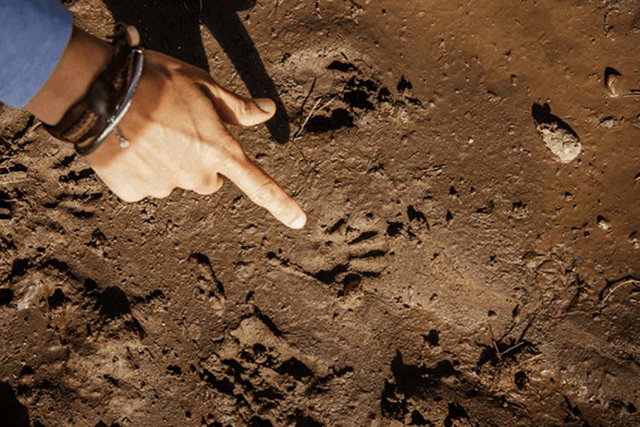
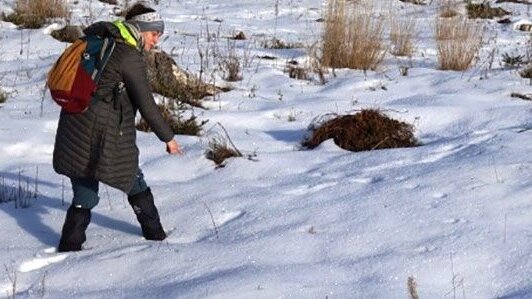
With our Wildlife training course: Tracking and Wildlife Observation, we take you into the world of our wild animals. You will learn to systematically recognize, identify, and interpret tracks, traces, and signs. We are always outdoors, but we will not focus only on what lies on the ground; we will try to perceive all the life around us. Tracking, animal communication, wildlife observation, and thinking in ecological contexts are one and the same. Much of what you encounter will first inspire wonder, then bring you further insights into understanding life.
Tracking creates a connection: with nature and with yourself
Tracking connects you deeply with your natural surroundings, especially the animals that leave their tracks and signs across the landscape. Each of these tracks tells you a story about the animal, and the more you explore them, the more you reconnect with the animals and the nature we all share. You develop a feel for and understanding of animals’ behavior and ways of life, recognize ecological connections, and can build profound relationships with animals. So much so that the animals and tracks you have followed leave their mark on you and broaden the way you see yourself.
Wildlife behavior is a powerful teacher
Deer fleeing from cranes, mourning wagtails, hooded crows playing with falcons, blackcaps warning pigeons, and herons allowing wolves to nearly tread on their feet in complete serenity: there is so much to discover in the “wilderness”—your home. You can learn how to approach animals, understand their language, and recognize that species fact sheets do not even begin to do justice to life in the wild.
Tracking is perception training
During this training, your perception will expand considerably, because tracking means perceiving with all your senses. It trains our attention and presence in the moment. Tracking is about being here and now. Our native mammals and birds will be our main guides. To that end, we will spend a great deal of time together outdoors in different landscapes and habitats, to get to know and cover as wide a variety of animals as possible. We learn from nature, with one another, and from one another. The community of a close-knit group is important to us. In the end, one campfire or another will illuminate not only the wonderful stories of the day just past.
Who this is for
The Tracking training course is for anyone interested in the subject who wants to explore tracking and wildlife behavior in greater depth. As a professional development course alongside work, it is aimed at people working in wilderness education, forestry, hunting, wildlife photography, environmental protection, and biology, as well as nature guides and rangers.
Instructors
The training course was designed and is led by Christian Meister and Achim Gehrke. Christian is the founder and owner of Naturabenteuer Niederrhein. He is a nature and wilderness educator, wilderness instructor, and certified tracker (assessed according to CyberTracker standards, Track & Sign Professional) and has worked with groups in nature for several years. Tracking is his great passion and what draws him outdoors every day: letting the landscape guide him, roaming, setting out to explore, and immersing himself in the world of animals.
Achim learns and teaches the language of nature. He has been studying birds of prey for many years and is a nature and wilderness educator and wilderness mentor. He is dedicated to getting to know animals and their behavior more deeply: quietly observing, reading tracks, bird language, and perceiving with all the senses. He leads forest excursions and seminars about wolves and the “language of the forest,” shows the flying skills of birds of prey and the grace of dung beetles, but also loves spending long periods out on his own. Want to know more?
Available dates
Contents
Track classification – which animal families are we dealing with, and what distinguishes their tracks?
Foot morphology – structure and characteristic features of the paws and feet of our native animals
Individual track studies – exploring the specific paw characteristics of individual species; for example, what distinguishes a fox’s tracks from a dog’s?
Gait studies – how does a fox move? Gaits tell us about the animal’s mood and help us understand what it was doing at that moment.
Sign analysis: feathers, bones, skulls, feeding signs, droppings, nests, etc.
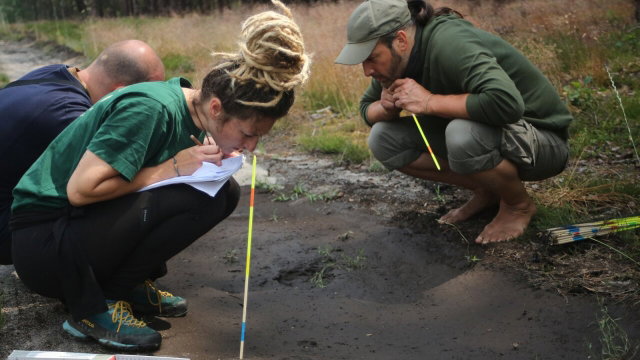
Measuring tracks & gaits – the tracker’s technical toolkit
Track documentation – building your very own track database
Setting up “track traps”
Journaling – a creative, effective tool for deepening personal experiences, encounters, and your individual learning journey
Track aging – when did the badger pass through here?
Bird language – what the birds can tell us.
Animal behavior – how and where do our animal neighbors live? What are their routines?
The art of asking questions – getting to the heart of the mystery by asking the right questions
Perception training – exercises to expand perception and awareness
Storytelling – around the campfire, the day’s stories take us on a journey through what we experienced
Mapping landscapes and animal tracks – recognizing movement patterns and routines
Animal observation
Tracking as a mirror of our inner wilderness – how tracking influences our personal development (Inner Tracking)
Structure
The training runs for 6 months and consists of 5 successive blocks (22 days in total).
Each block starts on Thursday at 6 p.m. and ends on Sunday at around 3 p.m.
Exception: Block 5 in the Lausitz starts on Monday at 6 p.m.
Between blocks, you will receive home study assignments to deepen what you have learned (approximately 3 hours of work per week).
Prerequisites
You should see yourself in the target group described above
otherwise, none
Packing List
We recommend the following equipment, depending on the season:
Tent, tarp, or hammock
Sleeping mat
Sleeping bag, possibly a small pillow
Weather-appropriate clothing
Hat and, if needed, gloves (cold season); sun protection (cap or hat for warm weather)
Weatherproof shoes and rubber boots
Biodegradable soap
Towel
Sitting mat!
Notepad and writing materials (pencils); waterproof paper is available.
Plate (shallow/deep), cup, and cutlery
Flashlight or headlamp
Small first aid kit
If available: binoculars, thermal imaging camera, wildlife camera.
Other personal essentials (e.g. small snacks, medication, etc.)
Board & Overnight
Event locations:
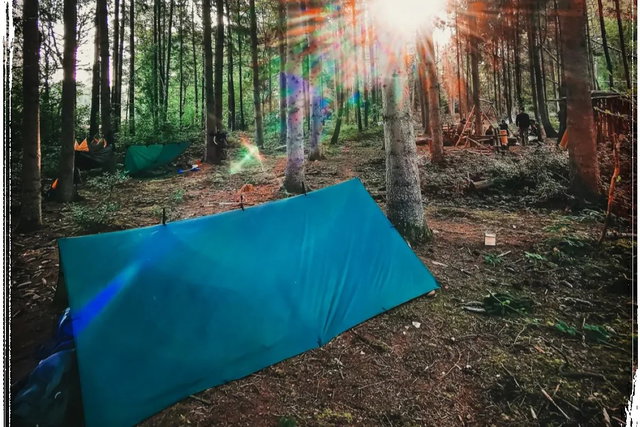
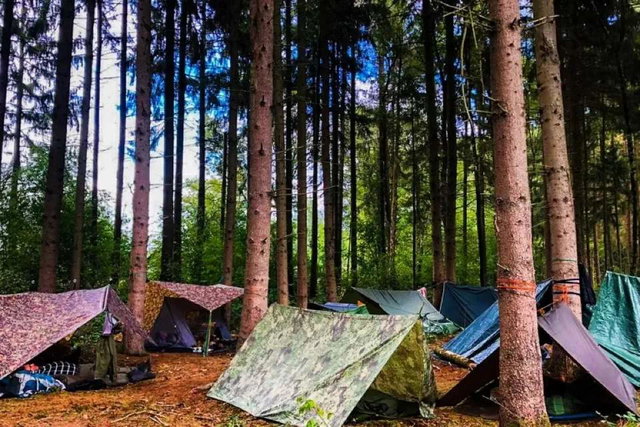
We start at our forest camp in Kevelaer. You can sleep here in a tent/tarp that you bring yourself. If you prefer fixed accommodation, you will find rooms and guesthouses nearby (not included in the price). From Kevelaer, we set out for different habitats in the border region between Germany and the Netherlands.
The final week takes place in Lusatia, a region full of wolves, deer, beavers, otters, eagles, and snakes. It will be an unforgettable conclusion to a year that will leave its mark on you. The starting point for this week is the Spreecamp run by wildlife photographer Karsten Nitsch in Neustadt an der Spree. Even here, you can observe animals and birds or read tracks. You can pitch your tent or stay in one of the rustic (multi-bed) log cabins (subject to availability at the time of booking). The camp has basic facilities, with showers (cold) and toilets, as well as a fire pit and covered seating areas. If you prefer fixed accommodation, nearby guesthouses “Zum Hammer” and “Zur Sorbenscheune” are alternatives.
Overnight stay in your own tent: €70 for the week.
Log cabin: You can find prices here.
Accommodation costs must be paid in cash on site.
Meals
Full board includes breakfast, packed lunches/lunch, and dinner.
Meals are largely vegetarian and of organic/Demeter quality.
Certificate
Upon completion of the course, the participant will receive a certificate issued by the Wildnisschule Naturabenteuer Niederrhein. To qualify for the certificate, participants must attend all modules and complete the home study assignments. The certificate provides an overview of the topics and content covered in the course.
Cost Structure
€2500/€2250 including meals and accommodation (at our sites), plus the cost of accommodation in Lusatia (see above)
Payment options: bank transfer of the full amount or a maximum of 10 installments of €250/€225 by direct debit.
Reviews
WildNet.Earth Review Policy
Each rating result ranges from 1 to 10. The overall rating for a class is calculated by adding up all the ratings submitted and dividing them by the number of ratings. We use a weighted system: more recent ratings have a greater influence on the overall result.
Participants can also submit sub-ratings for important class areas – such as organizer communication, class management, content & learning progress, procedure & implementation, venue, catering, and accommodation. Sub-ratings and overall ratings are assigned independently of each other and are not necessarily directly related.
Participants can submit a review if they have taken part in a class via WildNet.Earth – even if they have not completed the class in full. In addition, participants can verify themselves and also write reviews even if they have not booked via WildNet.Earth. Changes to reviews that have already been submitted can only be made via WildNet customer service.
To prevent bias, WildNet.Earth uses processes that identify fake or unreliable reviews. Such content will be deleted and measures may be taken against those responsible. Suspicious posts can be reported to customer service by anyone at any time.
We publish both positive and negative reviews, unless they contain or refer to:
- Politically sensitive content
- Advertising
- Illegal activities
- Personal or sensitive data (e.g., phone numbers, email addresses)
- Insults, obscene language, sexualized content, hate speech, discrimination, threats, or violence
- Spam or obviously fake content
- Identity theft
- Any violation of our rating guidelines
Guidelines and standards for reviews
These guidelines ensure that reviews on WildNet.Earth remain relevant, fair, and respectful—without restricting freedom of expression.
Contributions should have a clear connection to the class or experience and help other participants make an informed decision. Personal attacks, religious or political statements, advertising, or support requests (to the organizer or WildNet.Earth) do not belong in reviews and will be removed.
Posts must be suitable for a global audience. Obscenities (even in creative writing) and content that contains hate, discrimination, violence, sexual depictions, or illegal activities are not permitted.
All content must be authentic, independent, and unbiased. Organizers and their partners may not create reviews on behalf of their participants or offer incentives for reviews. Attempts at manipulation (e.g., negative reviews against other organizers) will not be tolerated.
Personal data of third parties may not be published. Copyrights must be observed—published content, especially images, may only be used if the corresponding rights have been obtained.
The opinions expressed are solely those of participants and class providers. WildNet.Earth accepts no liability for reviews or responses. WildNet.Earth acts as a distributor, not as a publisher of content.
Reviews are sorted according to recency and other relevance criteria (e.g., language, reviews with text, etc.). Additional sorting options may be available.
Fährtenleser Ausbildung
Rate your experience
Thank you for sharing your experiences. Your feedback helps other participants and supports the organizers in quality assurance.
A quick login is required to submit a review.
This ensures that only actual participants submit reviews, which increases the relevance of the reviews.
More classes from this school


Similar classes in the Tracking category






About the Organizer
Naturabenteuer Niederrhein
Nature Adventures Lower Rhine: Wilderness Education and Self-Discovery
Since 2015, at Naturabenteuer Niederrhein, we have been helping people connect with nature, one another, and themselves. Wilderness education is the foundation of our work. Outdoors, we learn to observe more closely, discover our own abilities, and dare to try new things.
The heart of our wilderness school is our wilderness education training program. It combines practical wilderness skills, self-discovery, and learning together as a community. Core nature-connection practices help you deepen your relationship with nature and engage with yourself more mindfully.
Survival trainer training and tracker training are further focuses of our work. They offer you the opportunity to explore each subject area in greater depth.
Our introductory and advanced courses range from the Wilderness Living Basics course to the Tracking Club and knife making, as well as “Daughters of the Earth,” our women’s wilderness course. The program is complemented by parent-child camps, programs for school classes and groups, and selected wilderness tours in Scandinavia.
Whatever path you choose, personal development and self-discovery are part of our work. Alongside the outer wilderness, there is also an inner wilderness for you to discover and explore.
Naturabenteuer Niederrhein: Wildnispädagogik und Selbsterfahrung
Seit 2015 begleiten wir bei Naturabenteuer Niederrhein Menschen dabei, sich mit der Natur, miteinander und mit sich selbst zu verbinden. Wildnispädagogik ist das Fundament unserer Arbeit. Draußen lernen wir, genauer wahrzunehmen, eigene Fähigkeiten zu entdecken und neue Erfahrungen zu wagen.
Das Herzstück unserer Wildnisschule ist die Wildnispädagogik-Ausbildung. Sie verbindet praktisches Wildniswissen, Selbsterfahrung und gemeinschaftliches Lernen. Kernroutinen der Naturverbindung helfen dir, deine Beziehung zur Natur zu vertiefen und bewusster mit dir selbst umzugehen.
Die Survival-Trainer-Ausbildung und die Fährtenleser-Ausbildung sind weitere Schwerpunkte unserer Arbeit. Sie bieten dir die Möglichkeit, tiefer in die jeweiligen Themenbereiche einzutauchen.
Unsere Kurse zum Kennenlernen und Vertiefen reichen vom Wildnisbasiskurs Wildnisleben über den Tracking Club und das Messerschmieden bis zu „Töchter der Erde“, unserem Frauen-Wildniskurs. Ergänzt wird das Angebot durch Eltern-Kind-Camps, Programme für Schulklassen und Gruppen sowie ausgewählte Wildnistouren in Skandinavien.
Welchen Weg du auch wählst: Persönliche Entwicklung und Selbsterfahrung gehören zu unserer Arbeit. Neben der äußeren Wildnis gibt es auch eine innere Wildnis, die du entdecken und entfalten kannst.
Hundreds more classes in 30+ categories
Not found what you are looking for yet? Discover many more classes in our class finder.